







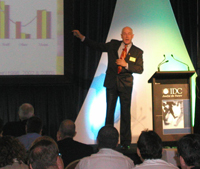
 Peter Hind is a highly-acclaimed public speaker. Peter has been actively involved
with Toastmasters for over 20 years and places an emphasis in his speeches on being
both entertaining and provocative. Some of the recent events where Peter has been
ranked the number 1 speaker at the conference include:
Peter Hind is a highly-acclaimed public speaker. Peter has been actively involved
with Toastmasters for over 20 years and places an emphasis in his speeches on being
both entertaining and provocative. Some of the recent events where Peter has been
ranked the number 1 speaker at the conference include:
- Volante resellers and users conference in Melbourne – October 2004
- IDC Singapore Directions conference in Singapore – April 2005
- IDC Australia Directions conference in Sydney – April 2005
- MIS IT Summit in Hong Kong – August 2006
- MIS IT Summit in Singapore – August 2006
- Marcus Evans Global CIO Conference in Kuala Lumpur - November 2006
From the experiences gained through running IT Executive Forums for over 12 years Peter has a wide understanding of most facets of the ICT industry. Moreover, he is able to draw on a multitude of research, anecdotes and case studies to embellish his speeches.
Some of the speeches Peter Hind has delivered in the last 18 months include:
Globalisation - making the world go round
Despite the current economic downturn governments and businesses are unlikely to shy away from globalisation. Many credit globalisation with fostering an extended period of economic growth and wider prosperity in the world. Globalisation though does present businesses with many new operational challenges. How can they better respond to new global business opportunities? How can they foster better collaboration between staff, clients and suppliers who may be based in a wide range of dispersed locations? In this presentation Peter Hind argues that to address these challenges CIOs need to harness the power of a number of new and emerging communication technologies which he believes will facilitate much stronger collaboration in the workplace.
Conquering the challenges of change and complexity
Peter Hind will contend that if IT managers are serious about mastering the task of aligning IT to the business then they need to pay close scrutiny to the challenges currently confronting their executives and determine how they can assist them in these areas. This speech will examine those current executive challenges and show how relentless change, growing complexity, the need to secure key executive talent and the pace of business are key issues facing CEOs. The speech will then outline strategies that Peter considers will help better position IT managers to assist their corporate executive overcome these hurdles.
The changing challenge of IT security
The primary method of computer security is rapidly changing. For much of the past three decades it entailed building impenetrable walls to keep outsiders from accessing the computer systems and allowing those inside the business to have privileged access to these corporate resources. Unfortunately, this model is rapidly losing its effectiveness. The borders of corporate networks have had to become more fluid and dynamic to accommodate a need for external access by a myriad of suppliers, outsourcers, contractors, mobile workers and clients. In such circumstances how can a CIO be confident their systems are secure? In this presentation well known industry analyst, author and IT commentator Peter Hind will explore these trends. His speech will examine what can be done to minimise the potential threats posed by third parties with access rights and how a CIO can focus on protecting the valuable information within business systems from potential internal and external attacks.
The brave new world of ITIL v3.0
ITIL v3.0 represents a major overhaul of the ITIL IT service management methodology. One of the reasons for this overhaul has been to help IT executives better address the task of aligning IT to the business. The centrepiece of ITIL v3.0 is the IT Service Catalogue. This catalogue lists the services that IT will deliver to the business, the frequency of those services, the quality of those services and what business is prepared to pay for them. However, while this sounds laudable the reality is that it will require a major commitment from the business to express and agree their requirements. In this speech Peter Hind will contend that for IT executives to secure this engagement from their business counterparts they will first need to articulate in business language how ITIL can help business executives achieve their own goals.
IT Strategies for mid sized businesses
Peter Hind contends that the tightening economic climate offers excellent opportunities for IT executives in mid sized Australian businesses to gain greater recognition in their organisations. However, he believes they will first need to demonstrate they are attuned to these economic forces now impacting their companies. In particular, he advocates that this is the time for IT executives to be proactive in promoting projects that involve rationalising the IT architecture and IT expenditure. Such tasks will entail activities like consolidating resources, automating manual operational tasks, deploying alternative financing approaches and examining other avenues to reduce fixed costs in the IT department budget. Peter argues that such projects will reflect empathy by IT executives to the demands currently confronting their business colleagues. Moreover, he also believes that such activities will free funds that, in time, can then be applied by the IT department towards more innovative investments.
Innovate or perish
Research is increasingly showing that CEOs recognise that the path to sustaining
and enhancing corporate growth lies with innovation rather than cost-cutting. Today
CEOs are needing solutions to boost productivity and to grow the top line by enabling
their organisations to respond more rapidly to the relentlessly changing business
world of today. In this presentation Peter Hind, the ICT author, journalist and
industry analyst, will examine these trends. He will draw on Asia Pacific research
to show that local CIOs need to elevate their thinking from operational matters
and he will highlight how CIOs can free themselves to provide strategic long term
change for their businesses
The art of governance
The current obsession with IT governance seems to owe much to a corporate concern
that many IT promises of the past have been unfulfilled. However, in this presentation
Peter Hind, the IT author and industry commentator, will contend that there is much
more to IT governance than setting up the CIO to be target practice for their counterparts
in the business. In fact, Peter will argue that pursuing strong IT governance processes
will provide the mechanism for IS executives to address many of the major issues
they have faced over the years
The business case for greater use of mobility solutions
Research shows that the adoption of mobility technology has grown dramatically in
the last ten years. However, has business only really succeeded in just picking
the low hanging fruit? Despite the growing popularity of mobility technology the
evidence seems to be that all CIOs and their technology suppliers have done when
implementing these solutions is to provide “road warriors” with the latest toys.
Renowned IT author, CIO columnist and industry analyst Peter Hind will contend that
the real potential of mobility technology is to transform how organisations are
structured and where they are located. His presentation will show the significant
cost savings that organisations could reap if they were serious about fully harnessing
the proven functionality of mobility technology for all their workers.
Trends in the use of IT in Asia Pacific
Peter Hind's presentation will harness findings from the recent MIS IT Leaders Agenda
survey. This was commissioned by MIS Asia Magazine in conjunction with Peter and
covers seven countries in this region. Peter’s speech will provide insights into:
how the IT budget varies between Asia Pacific countries; the technologies being,
or intending to be, adopted by Asia Pacific IS executives and the key issues IT
executives in this region are facing. As a backdrop to this presentation Peter will
position the usage of ICT against the business drivers, challenges and overall economic
climate in this part of the world.
Offshoring - does the CIO still call Australia home?
Offshoring is clearly a highly contentious issue. Organisations like Westpac and
Qantas have both recently announced their intention to source IT services from India.
Yet these announcements have been greeted by a storm of protests and threats of
a consumer backlash. Yet, on the other hand, the Business Council of Australia is
a passionate advocate for offshoring believing it will help increase global trade
and enable Australian companies to be more competitive. So what are the true facts
about offshoring? Is it a short-term expediency? Will it eventually boost jobs?
Will it really save money or will there be hidden costs? What are the factors that
need to be considered to make it work? Will offshoring help local CIOs address skill
set shortages? These questions and more will be explored in this presentation by
Peter Hind.
Trends and challenges in IT security
Each year since 2002 the Australian Computer Crime and Security (AusCERT) survey
reveals the main electronic security challenges facing local businesses. Carried
out by the University of Queensland the AusCERT study highlights that, despite the
almost universal adoption of anti-virus software and firewalls, only 7% of respondents
felt confident they were on top of the IT security challenges facing their business.
It seems the nature of these attacks is changing. New threats such as identity theft
and denial of service attacks are appearing and the financial exposure to Australian
business is increasing. In this presentation, Peter Hind, the well known ICT industry
analyst, will explore these trends to highlight to Asia Pacific IS executives the
major IT security challenges they face or are likely to encounter, the cost of these
threats to business and what tactics are being deployed to address these issues.
Business Continuity Planning – how to harness these business trends
We undoubtedly live in anxious times. Over the last few years there seems to have
been a succession of crises that have emerged all of which could have the potential
to severely disrupt business operations. Research last year by the Financial Times
and CSC Leading Edge Forum found that business and IT executives around the world
rated assuring sufficient security and disaster recovery as the top IT priority
in their organisation. However, given the magnitude of some of these threats, and
limited resources available to many CIOs, how should IS executives address the issue
of business continuity planning. Is there a practical balance between a cavalier
indifference to these potential threats and a neurotic over anxiety? Peter Hind
will explore the tactics and strategies CIOs are deploying to address the business
continuity planning needs of their organisations. He will explore how organisations
draw up these plans, what crises management elements are in place, how responsibilities
are shared by both business and IT executives and how these plans are communicated
to the business at large.
Better managing the desktop
According to McKinsey’s, infrastructure typically accounts for some 40 to 60 per
cent of a company’s IT costs. However, some times, despite their best endeavours,
IT executives find many of these costs are largely inflexible. The desktop seems
to fit into such a category. Most employees require a PC and the operating systems,
hardware and applications change frequently necessitating regular and costly upgrades.
However, CIOs are increasingly examining creative ways to contain the costs of desktop
management. In this presentation Peter Hind will recount the tactics CIOs are adopting
to achieve major reductions in support costs for PCs and how they are significantly
simplifying the task of desktop asset management.
Getting value from outsourcing
The IT industry has wrestled for years with determining the best way to source staff
resources. From bureaus to insourcing to contractors to outsourcing to offshoring
combinations of many of these approaches have been tried over the years. Yet there
is little industry consensus as to which approach is the most operationally efficient
and cost effective. Peter Hind will draw on the latest Asia Pacific research to
see where IT executives in this region are making the most use of outsourcing. His
speech will also show where and how the external sourcing of IT functionality can
bring the most value to business.
eGovernment in Asia Pacific
Government agencies across Asia Pacific are becoming increasingly burdened with
budget constraints, fewer available resources, and a mountain of new demands from
both legislative groups and ministries. To meet these challenges, leading agencies
are adjusting their focus on eGovernment initiatives. Rather than viewing eGovernment
programs as independent projects, many agencies are embarking on a constant pursuit
of operational transformation to improve efficiencies and to better serve their
citizens. To better understand these initiatives Peter Hind recently undertook the
‘Asia Pacific eGovernment Readiness Survey’ on behalf of MIS Magazine and FileNet.
In this presentation Peter will reveal the findings and trends in eGovernment initiatives
revealed by more than 100 public sector agencies across the Asia Pacific region.
Aligning IT to the business
How best to ensure an alignment of IT activity with the needs of the business has
probably been the biggest challenge reported by IS executives over the last decade.
However, IT often finds itself at the mercy of short sighted vision from the business
executive who often want from IT financial caution as well as a framework to satisfy
future expansion needs. In this presentation Peter Hind, the IT author and industry
commentator, will discuss the tactics that have been successfully used by IS executives
to enhance the inter-action between IT and the business.
Using new telecommunication services for greater corporate flexibility
The days when businesses could confidently plan for the future are long gone. The
task for executives today is to respond swiftly to challenges as and when they arrive.
This requires the ability for the organisation to turn on a sixpence to deal with
each threat and opportunity. IT has to facilitate this change. It cannot be seen
to hinder business progress. However, it also has to deliver this as efficiently
as possible to satisfy the relentless pressure in business to do more with less.
In this presentation, Peter Hind, the renowned IT author and freelance industry
commentator, will outline the drivers behind this need for corporate flexibility.
His speech will show how many businesses are increasingly dependent on the capabilities
of their telecommunications infrastructure to meet these growing demands. In addition,
he will look at how this is leading to changes in the telecommunication components
they utilise.
Business process efficiency - where IT gives competitive advantage
The growing evidence is that CEOs recognise that the path to sustaining and enhancing
corporate growth lies with innovation rather than cost-cutting. The goal today is
to boost productivity and enable their organisations to respond more rapidly to
the relentlessly changing business world of today. In this presentation Peter Hind,
the well known ICT author, journalist and industry analyst, will examine these trends.
He will draw on research from a number of sources, including McKinsey’s, to highlight
why executives need to improve their business process efficiency. He will explain
to achieve this and what outcomes IT executives could realise seek from these activities.
Harnessing Business Intelligence
Research at the University of California, Berkeley has revealed that the volumes
of worldwide stored information has been growing at 30% a year. Business Intelligence
(BI) systems seek to help organisations separate the wheat of information from this
chaff of voluminous data. At this presentation well known local IT analyst Peter
Hind will outline the business drivers behind the adoption of BI applications, where
and how these applications are being applied by business, the challenges users face
in exploiting the potential of these systems and the growing potential of this technology.
Building teamwork in the IS department
Research shows that over a third of IT professionals have been retrenched at some
stage of their career. Clearly, the concept of job security is foreign in the dynamic
corporate world of today. How then do you go about building teamwork when many workers
feel they are operating in personal survival mode? Peter Hind will outline the tactics
harnessed by CIOs in building teamwork in these challenging times. This presentation
will examine better ways for IT executives to foster cultural change, corporate
communication, line manager empowerment and engagement with the business.
Gold in those hills – the potential of multi-function peripherals
Research shows that the multi-function peripheral (MFP) device market is the fastest
growing sector in the ICT industry. On the one hand they satisfy cost containment
pressures in business because they consolidate corporate peripheral devices for
cost savings in support and consumables. On the other hand they address corporate
pressures for better document production and management. In this presentation, Peter
Hind, the IT author and experienced industry commentator, will examine why more
and more CIOs are implementing MFP devices and how this market is likely to evolve
over the next five years.
Avian bird flu – it’s going to happen any day soon
The evidence seems to point conclusively to the fact that a major global flu pandemic
will re-occur, probably in the near future. Without a known cure the only way authorities
can deal with this threat is through the use of quarantine and isolation to reduce
human-to-human interaction. By its very nature this approach will place a heavy
reliance on IT to facilitate greater remote contact between employees, clients and
suppliers. In this presentation, Peter Hind, the IT industry analyst, will outline
what CIOs need to do to ensure their IT environment is set up to effectively handle
these challenges.